Article
When the water rises, the first challenge is often not the rescue itself. It is reaching the people who need to be rescued.
A flood does more than inundate a road or a settlement. It can disrupt the very routes through which help is supposed to arrive.
Roads disappear beneath water. Bridges become unusable. Vehicles may no longer be able to pass. Strong and unpredictable currents can make boats difficult to operate, while debris and damaged infrastructure can create additional risks. Places that were accessible yesterday can become unreachable today.
That changes the nature of rescue.
The question is no longer simply, “How do we rescue?”
It becomes, “How do we reach?”
This is where unmanned systems can play an increasingly important role.
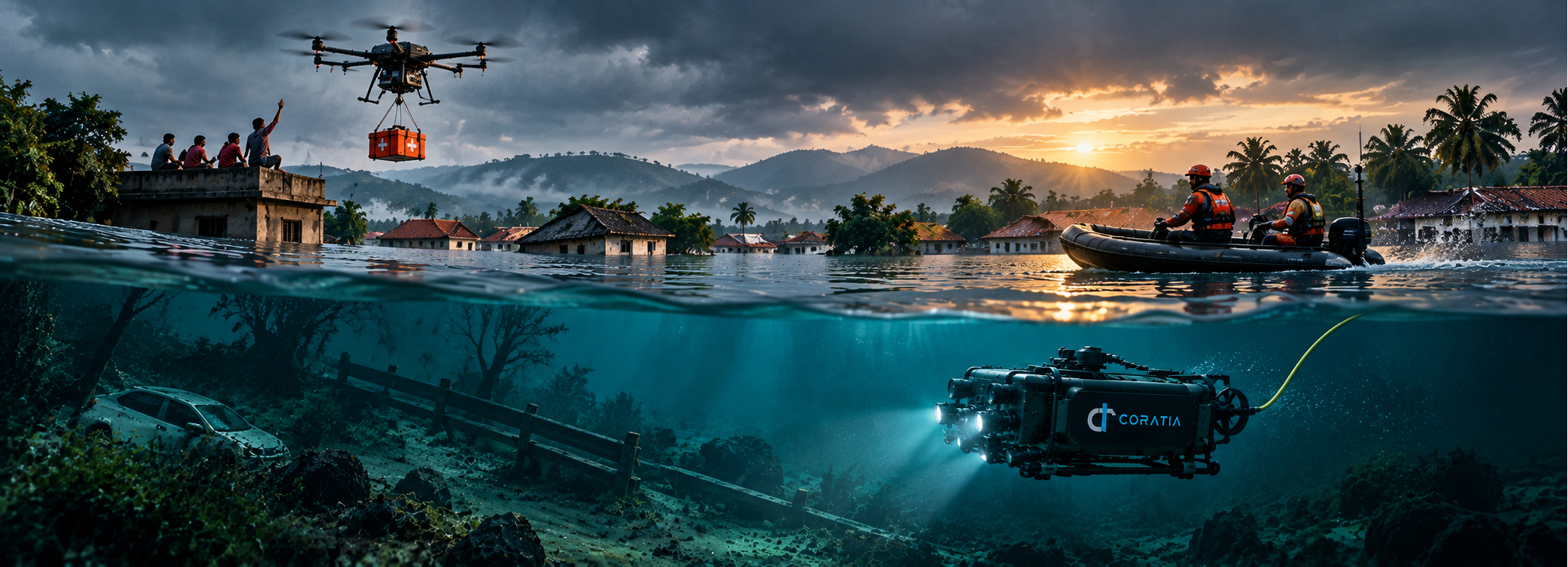
When conditions are too dangerous or difficult to access, unmanned technologies can give responders a better view without immediately putting people in harm’s way. Drones and remotely operated systems can help survey affected areas, assess water conditions, identify possible routes, locate stranded people and support emergency teams with real-time information.
They can also help deliver essential supplies to areas where conventional vehicles cannot reach. This can be especially valuable in the early stages of a disaster, when roads may be blocked and response teams are still assessing the situation.
But the larger opportunity lies in preparing these technologies before a crisis occurs.
Disaster-response technology cannot be designed only for ideal conditions. Real emergencies bring limited visibility, strong currents, floating debris, damaged infrastructure, uncertain terrain and disrupted communication. Systems built for these situations need to be tested against these realities.
Effective disaster-response technology also needs to work as part of a larger response system, supporting the people making decisions on the ground rather than replacing them. Its value lies in giving responders better visibility, greater reach and information that can help them act more effectively.
Most importantly, these capabilities need to exist before they are urgently required.
Disaster-response technology needs to be built before the disaster, not improvised after it.
For a country like India, where flooding can affect cities, rural communities and critical infrastructure alike, developing technologies suited to local conditions can become an important part of building more resilient emergency-response systems.
At Coratia, this is the problem space we care about.
Our focus on robotics and unmanned systems comes from a simple premise: technology should extend human capability, particularly when conventional access reaches its limits.
A disaster will always bring uncertainty. The goal is not to eliminate that uncertainty, but to give response teams better tools to navigate it.
Because when roads disappear, currents become unpredictable and conventional access ends, technology should help the rescue effort continue.
The future of disaster response will not only be about responding faster. It will also be about making it possible to reach places that conventional rescue systems cannot.