Article
In September 2025, several subsea cables were damaged in the Red Sea near Jeddah, including SMW4, operated by Tata Communications, and IMEWE. Internet monitoring group NetBlocks reported degraded connectivity across multiple countries, naming India and Pakistan among them, and Microsoft warned customers of increased latency. The cause was not immediately clear.
Incidents like this are a reminder that India’s digital economy depends on physical infrastructure lying on the seabed, much of it far from Indian control. They have also pushed a long-standing gap into the policy spotlight: India’s ability to find, assess and fix cable faults quickly.
India’s cable exposure is concentrated
Subsea cables carry close to 99% of global data traffic. India’s share of that network is relatively small and geographically concentrated. TRAI’s chairman said in January 2025 that India hosted around 17 international subsea cables across 17 cable landing stations; later counts put the figure at 18 to 19 international systems. Landings are spread across only five cities: Mumbai, Chennai, Kochi, Tuticorin and Thiruvananthapuram. Mumbai carries the heaviest load, handling around 95% of India’s international bandwidth, and at least 13 intercontinental cables converge along a roughly six-kilometre stretch of Versova beach, a concentration flagged as a single-point-of-failure risk for westbound traffic. The consequences of disruption are not hypothetical: in January 2008, cable damage near Alexandria, Egypt, initially affected 50–60% of India’s international bandwidth.
The repair gap India is trying to close
India has no Indian-flagged or Indian-owned cable repair vessel. Indian waters are served by two maintenance providers based in Singapore and Dubai, and the nearest cable depot is in Galle, Sri Lanka. [2] Typical repair turnaround in Indian waters has been put at four to five months.
Policy is now moving. In August 2026, the Department of Telecommunications opened talks with industry and the Directorate General of Shipping on domestic repair capability. A joint committee including the shipping ministry, the Navy, the National Security Council Secretariat and the DoT is examining options, including retrofitting two Indian Navy diving support vessels launched in 2022. A confidential public-sector study reportedly estimated ₹3,000–4,000 crore for indigenous vessels and interim maintenance infrastructure. Separately, the DoT is developing a single-window portal to speed up repair clearances, with March 2027 identified as a tentative implementation target.
These are the right steps, but they take time. A new cable repair ship typically takes three to four years to build. In the meantime, there is another layer of resilience that does not depend on a ship: knowing the condition of the cable route before and after something goes wrong.
Why inspection is a separate capability
Repair is the last step in managing a cable incident, not the first. Before a repair ship can work efficiently, operators need to locate the fault, understand the seabed conditions around it, and establish what caused the damage. After the repair, they need to verify the condition of the route.
Most cable damage is caused by ordinary human activity rather than sabotage. Dragged ship anchors alone account for roughly 30% of cable incidents each year, around 60 faults, according to the International Cable Protection Committee, and fishing and anchoring together have historically accounted for about two-thirds of all faults. Fishing and anchoring are concentrated in coastal and continental-shelf waters, the same busy nearshore zones where India’s cables approach their landing stations.
Depending on the site and mission, an underwater inspection can help teams:
- Confirm the cable’s route and burial status relative to the seabed.
- Identify sections that have become exposed or where seabed change has altered the surrounding conditions.
- Document visible evidence of anchor drag, fishing gear or other external interference.
- Give repair crews site-specific information before they mobilise, and verify the route after work is complete.
Inspection also has a preventive role. Surveys repeated at regular intervals build a record of how a cable corridor changes over time, helping operators prioritise vulnerable sections before a fault occurs.
Where Coratia fits
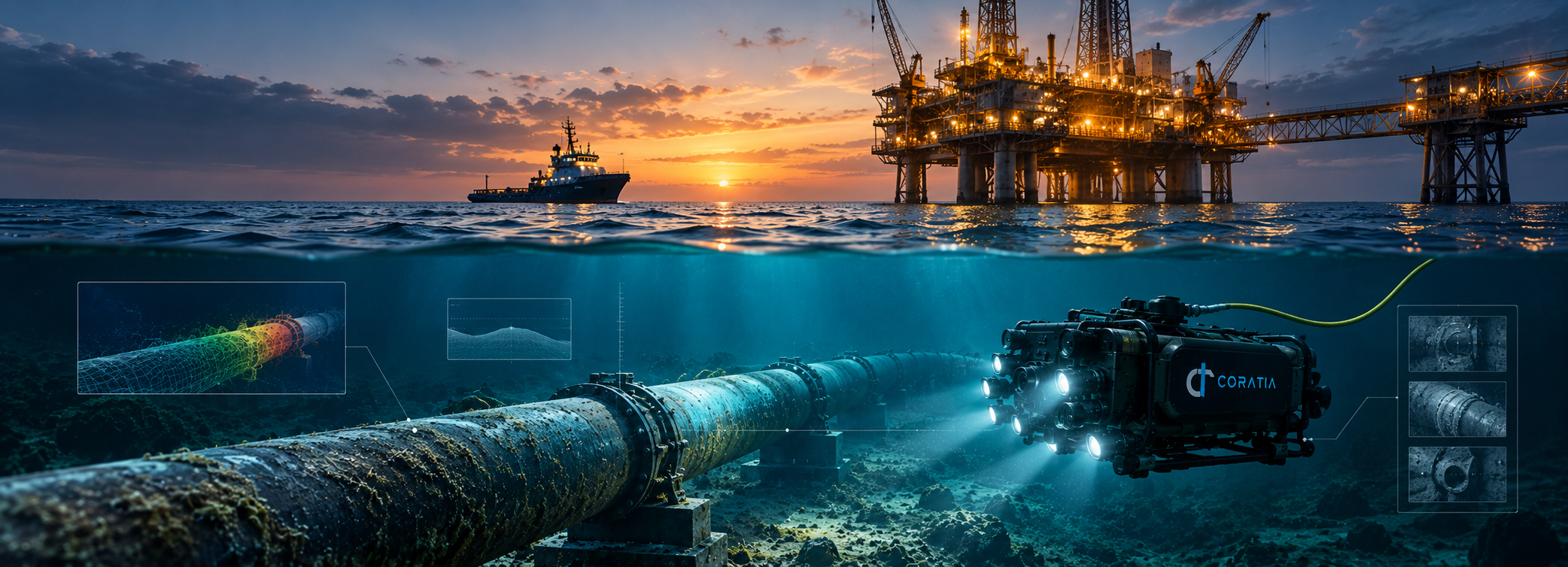
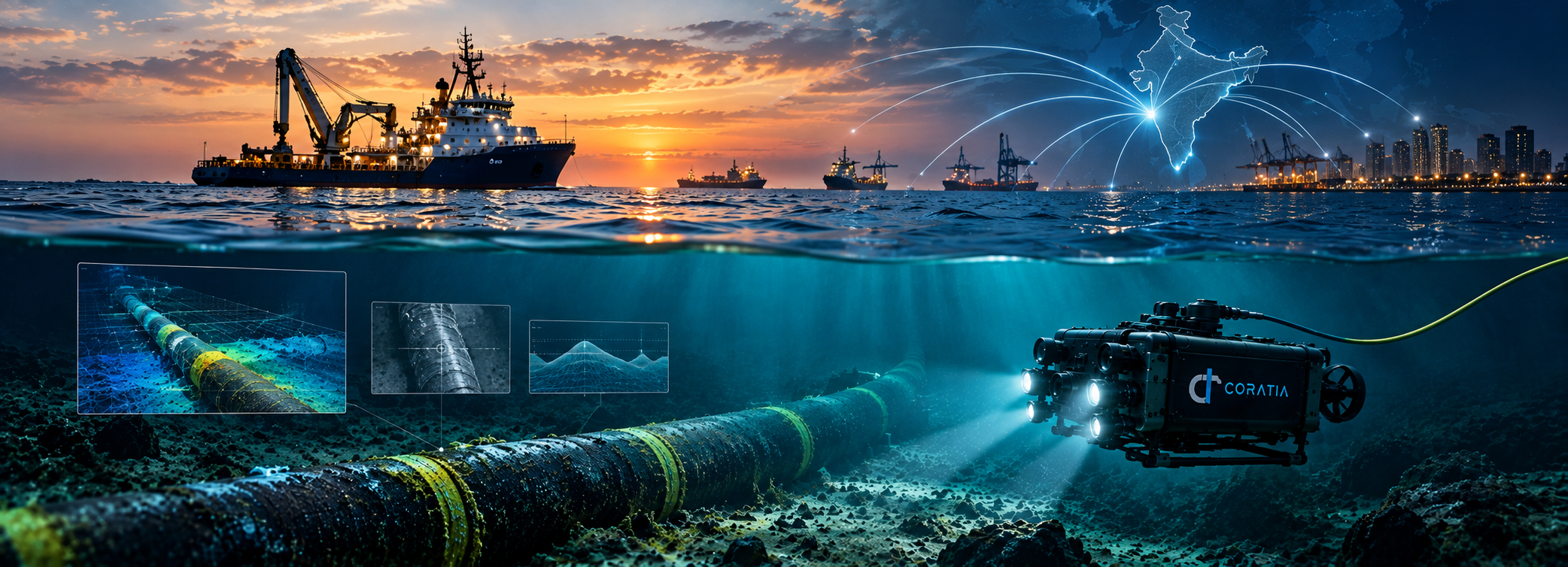
Coratia Technologies lists subsea cable inspection among its unmanned surveillance services, alongside submerged pipeline surveys and ocean topography monitoring. Its JalaSimha ROV, rated for operations up to 300 metres, has been equipped for undersea data-cable inspection. It carries a stereovision system for three-dimensional imaging, a robotic arm and NDT equipment, and Coratia’s AI-based inspection services add real-time defect identification and image enhancement for low-visibility conditions. For mapping the seabed along nearshore cable approaches, Coratia’s Navya autonomous surface vessel carries a dual-frequency echosounder for depth profiling and hydrographic survey.
This capability is best suited to nearshore approaches, landing zones and continental-shelf corridors, which are the stretches most exposed to anchoring and fishing activity. It is not a substitute for the deep-water cable-repair capability required at thousands of metres, and an inspection ROV does not replace a cable ship. The two are complementary: inspection tells the repair team where to go and what it will find; repair restores the service.
Coratia’s ROVs are already used in defence settings. In September 2025, the Indian Navy signed a ₹66 crore contract with Coratia for the supply and maintenance of indigenous underwater ROVs. [14] As India builds sovereign repair capacity, domestically developed inspection technology offers a parallel capability that can be deployed without waiting for new vessels.
Building a complete resilience strategy
A resilient subsea cable network needs several layers working together: route and landing-point diversity, fault monitoring, fast repair approvals, access to repair vessels and spares, and reliable data on the condition of vulnerable sections. India is now addressing several of these at once, through new landings on the east coast, the proposed repair-clearance portal and the repair-fleet discussions.
Inspection belongs on that list. Regular route surveys, accurate positioning and documented observations can turn isolated dives into a usable record of how India’s most critical cable corridors change over time.
The takeaway
Subsea cable security is not only about how quickly a damaged cable can be repaired. It is also about how well operators understand their routes, how quickly they can investigate a fault, and whether they have reliable information to guide maintenance. Repair ships will take years. Indigenous underwater inspection capability can contribute now.