Article
Why Subsea Pipeline Integrity Matters
India's offshore energy infrastructure depends on an extensive network of subsea assets that support the exploration, production and transportation of oil and gas.
Among these, subsea pipelines play a particularly important role. They connect offshore production facilities, platforms and associated infrastructure, enabling the movement of hydrocarbons across challenging marine environments.
However, operating beneath the sea introduces inspection and maintenance challenges that are not encountered in conventional onshore pipeline systems.
Subsea pipelines are exposed to seawater, changing seabed conditions, currents, marine growth, external interference and long-term material degradation. Over time, these factors can affect pipeline condition and increase the importance of regular inspection.
For operators, maintaining asset integrity involves more than responding to visible damage or reported faults. It requires understanding how pipeline conditions change, identifying potential risks and collecting reliable information to guide maintenance decisions.
This is where subsea pipeline inspection using Remotely Operated Underwater Vehicles (ROVs) can play an important role.
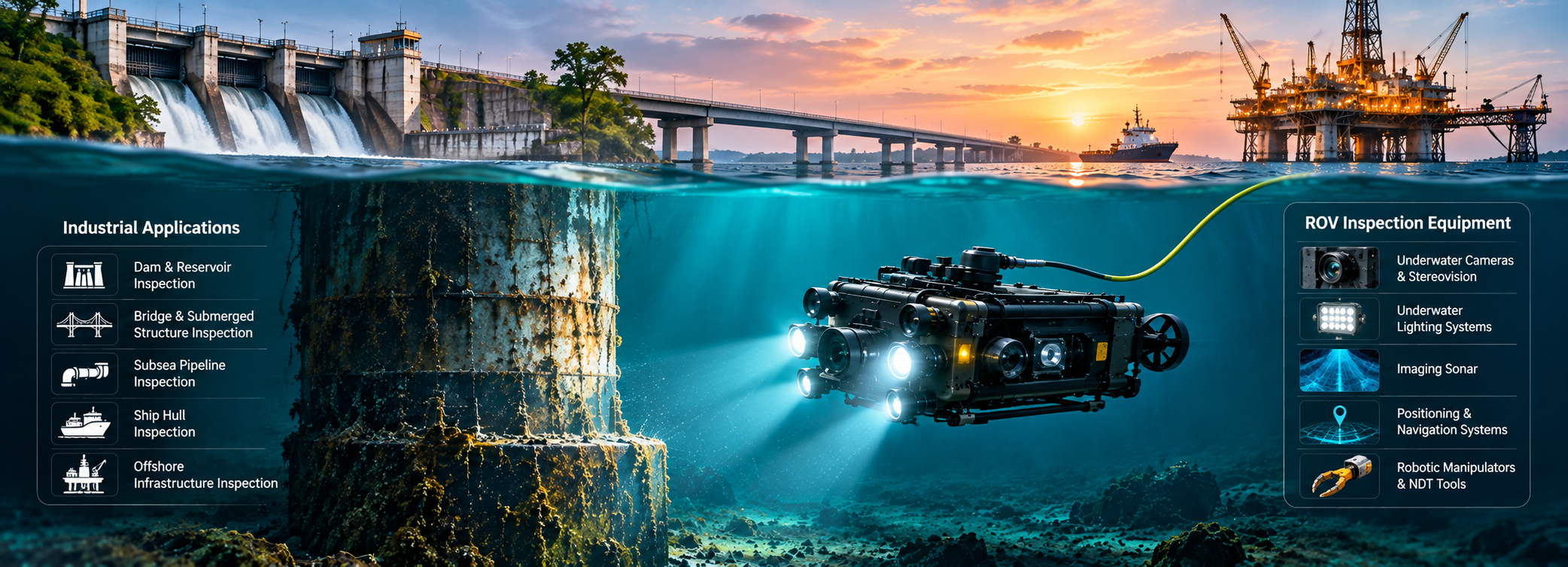
By providing remote access to submerged infrastructure and enabling visual, sonar and measurement-based inspections, ROVs help operators assess accessible pipeline sections without depending exclusively on diver-based operations.
Understanding the Challenges of Underwater Pipeline Inspection
Unlike onshore pipelines, subsea pipelines cannot be routinely accessed through conventional visual checks. Their condition must be assessed in an environment where visibility, accessibility and operating conditions can change significantly.
Some of the major challenges include:
1. Corrosion and Material Degradation
Continuous exposure to seawater can contribute to corrosion, particularly where protective coatings or corrosion protection systems are damaged or compromised.
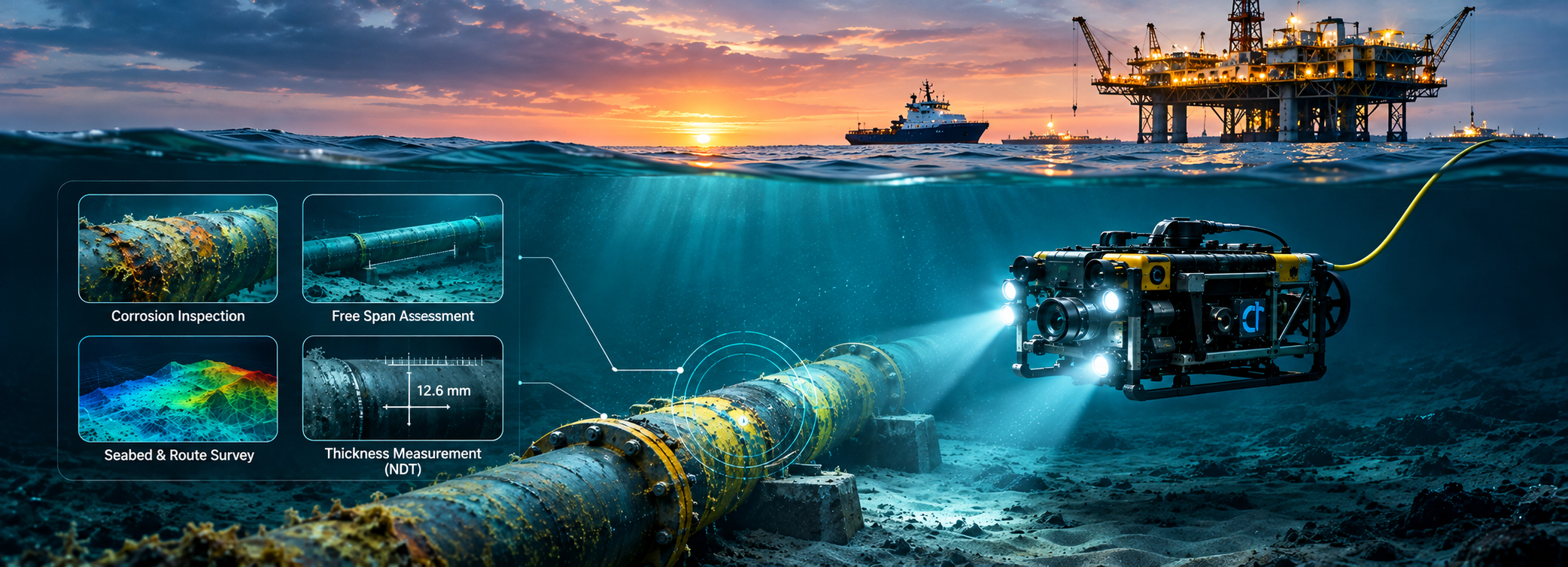
Over time, corrosion can affect pipeline wall thickness and material condition. Identifying visible corrosion indicators and conducting appropriate measurements are important aspects of offshore pipeline inspection.
2. Free Spans and Seabed Changes
A free span occurs when a section of a pipeline is unsupported by the seabed, leaving it suspended between support points.
Changes in seabed conditions, erosion and sediment movement can contribute to the development or extension of free spans.
Unsupported pipeline sections may be exposed to additional mechanical stresses, making their identification and monitoring an important part of subsea pipeline inspection.
ROV surveys can help identify and document accessible free spans for further engineering assessment.
3. External Interference and Physical Damage
Subsea pipelines may be exposed to external interference from anchors, fishing activity, dropped objects and other seabed operations.
Such incidents can cause physical damage, displace pipeline sections or disturb their surrounding seabed conditions.
Underwater pipeline inspection can help identify visible signs of external interference and provide information for further investigation.
4. Changes in Burial Depth and Pipeline Exposure
Some subsea pipelines are buried or covered to provide protection against external interference and environmental conditions.
However, seabed movement and erosion can alter the surrounding sediment, potentially exposing sections that were previously buried.
ROV-based surveys can help document exposed pipeline sections and changes in the surrounding seabed, providing information for further engineering assessment.
How ROVs Support Subsea Pipeline Inspection
A Remotely Operated Underwater Vehicle is an underwater robotic system controlled by an operator from a surface station.
For offshore pipeline inspection, the ROV is configured with equipment suited to the pipeline's location, depth, surrounding environment and inspection requirements.
Rather than relying on a single inspection method, ROVs can combine multiple technologies to collect different forms of evidence.
1. Visual Inspection of Pipeline Conditions
Underwater cameras allow operators to examine accessible pipeline sections and document their external condition.
High-resolution imaging can help identify visible coating damage, corrosion indicators, marine growth, debris, exposed sections and other surface anomalies.
Recorded footage provides a visual reference for engineering teams and can be compared with observations from subsequent inspection cycles.
2. Pipeline Route and Free-Span Assessment
ROVs can follow defined pipeline routes to document the condition of accessible sections, supports, crossings and exposed areas.
Visual imaging and sonar can help document accessible pipeline sections, identify potential free spans and record changes in the surrounding seabed.
These observations can be used to identify areas requiring closer examination or further engineering analysis.
3. Underwater Corrosion Inspection and Thickness Measurement
Corrosion monitoring is an important part of subsea asset integrity management.
ROVs can be configured with suitable non-destructive testing equipment, including ultrasonic thickness measurement tools, to collect information about material thickness at selected inspection points.
Such measurements can help engineering teams assess potential material loss and compare findings against previous inspection records.
The effectiveness of these measurements depends on surface preparation, probe access, coupling conditions, equipment configuration and the inspection procedure being followed.
4. Sonar-Based Inspection
In offshore environments, underwater visibility may be affected by suspended particles, marine conditions and depth.
Imaging sonar can support pipeline inspection by helping operators identify structures, surrounding objects and seabed features when camera visibility is limited.
Sonar data can also complement visual records by providing additional information about pipeline geometry, surrounding terrain and potential obstructions.
5. Inspection of Supports, Joints and Associated Infrastructure
A subsea pipeline system includes more than the pipeline itself. Supports, crossings, connections and associated structures also require attention.
ROVs can help examine accessible components, document their external condition and identify visible anomalies that may affect the surrounding installation.
This broader approach is important because pipeline integrity depends on the condition of the entire system and not just the pipeline wall.
From Inspection Data to Asset Integrity Management
The value of ROV-based inspection lies not only in the ability to reach underwater infrastructure but also in the quality and consistency of the information collected.
An effective subsea inspection programme should produce records that can be used to support engineering decisions over the asset's operational life.
A typical inspection workflow involves four stages:
1. Inspection Planning
The process begins with understanding the pipeline route, available engineering drawings, previous inspection records, water depth, operating conditions and areas of concern.
The inspection objectives determine which sections need to be examined and what equipment will be required.
2. ROV Configuration and Deployment
The vehicle is configured with suitable cameras, lighting, sonar, positioning systems and measurement equipment based on the mission requirements.
The ROV is then deployed to conduct the inspection along the identified pipeline sections.
3. Data Collection and Documentation
During the mission, operators capture video, still images, sonar information, positional references and measurements where included in the inspection scope.
Observations are linked to the relevant pipeline sections to support subsequent technical review.
4. Engineering Assessment and Maintenance Planning
The collected information is organised into inspection records and reviewed by the relevant engineering or asset integrity teams.
These records can help operators identify areas requiring further assessment, prioritise maintenance activities and compare observations across inspection cycles.
It is important to distinguish between inspection evidence and an engineering integrity assessment. ROV data supports the assessment process, while conclusions about structural condition and remaining service life require appropriate engineering analysis.
The Indian Offshore Infrastructure Context
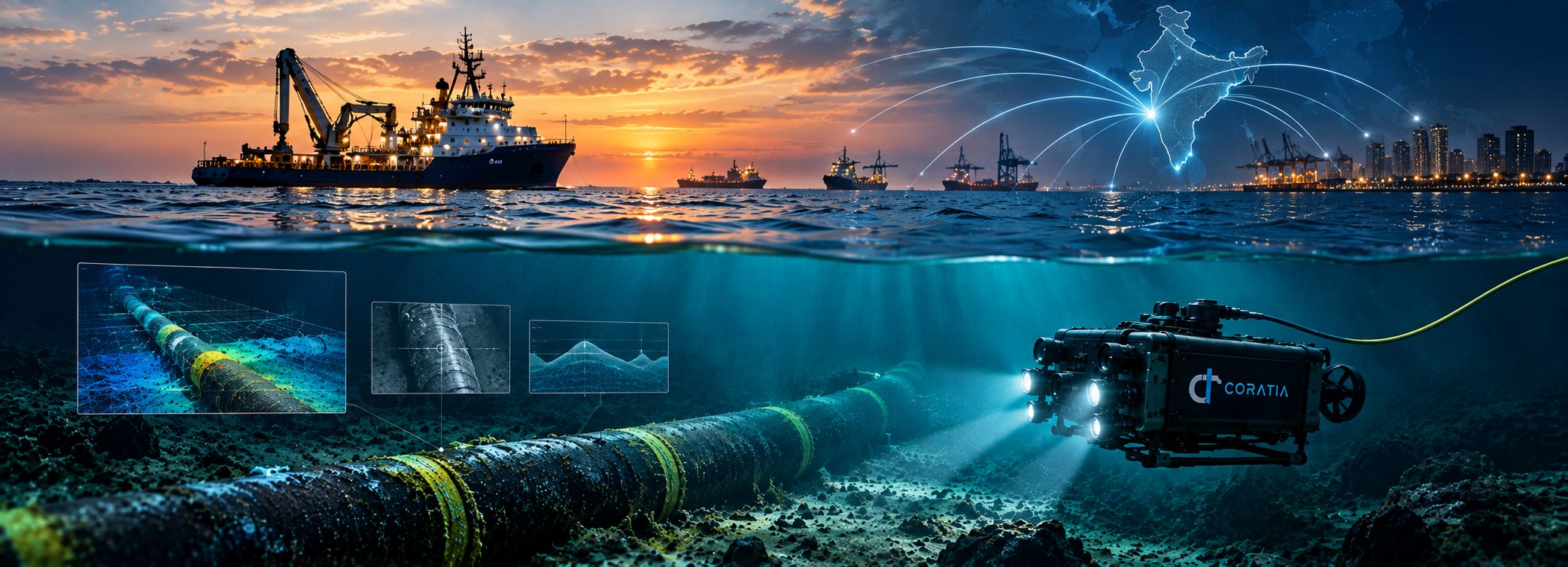
India's offshore energy infrastructure is undergoing continued modernisation, with pipeline replacement and rehabilitation forming an important part of the process.
India's offshore energy sector relies on extensive subsea infrastructure to support oil and gas production and transportation. Maintaining these assets requires regular inspection, monitoring and maintenance, particularly as existing infrastructure continues to operate in challenging marine environments.
As offshore infrastructure expands and existing assets undergo modernisation, underwater inspection technologies can support operators in documenting pipeline conditions and identifying areas that require further assessment.
Projects of this scale underline the importance of understanding the condition of existing assets before intervention and maintaining reliable inspection records throughout their operational life.
ROV-based inspection is relevant to this requirement because it enables operators to collect information from submerged sections that are difficult to access through conventional methods.
As India strengthens its domestic offshore capabilities, there is also an opportunity to develop indigenous underwater robotics systems that are suited to local operating environments and industrial requirements.
How Coratia Supports Offshore and Subsea Inspection
At Coratia Technologies, offshore ROV inspection services cover subsea pipeline route assessment, free-span and support checks, platform structures, risers, corrosion evidence, coating conditions and ultrasonic thickness measurement where configured.
The company's JalaSimha ROV has a depth capability of up to 300 metres and features a stereovision system, an integrated robotic arm and NDT equipment, including a thickness gauge and laser scaler.
These capabilities support underwater visual inspection, manipulation and selected material-condition measurements, depending on the inspection requirements.
Coratia's offshore inspection approach combines robotic access with visual, sonar, positional and measurement-based data collection. The information is documented to support further review by the relevant engineering and asset integrity teams.
Building a More Proactive Approach to Subsea Asset Integrity
Subsea pipeline integrity is not a one-time assessment. It is an ongoing process that requires operators to understand changing environmental conditions, monitor material performance and identify potential concerns before they develop into larger operational problems.
ROVs contribute to this process by making underwater inspection more accessible and enabling the collection of repeatable visual, sonar and measurement-based information.
As India's offshore infrastructure continues to expand and existing assets undergo modernisation, the ability to inspect and assess subsea systems will remain an important part of long-term asset management.
The future of offshore pipeline integrity will depend not only on how effectively pipelines are installed or repaired, but also on how consistently their condition is understood throughout their operational life.
Because the reliability of offshore infrastructure depends on what we can see, measure and understand beneath the surface.