Article
Understanding ROV Underwater Inspection
Much of the infrastructure that supports industrial operations lies beneath the water's surface. From dam gates and bridge foundations to offshore pipelines, ship hulls and subsea structures, these assets require regular inspection to maintain their structural condition and operational reliability.
However, inspecting submerged infrastructure presents a distinct set of challenges. Limited visibility, water pressure, strong currents, restricted access and the risks associated with underwater operations can make conventional inspection methods difficult to execute.
This is where ROV underwater inspection becomes increasingly important.
A Remotely Operated Underwater Vehicle (ROV) is an underwater inspection robot controlled by an operator from the surface. Equipped with cameras, lighting systems, sonar, positioning sensors and specialised inspection tools, an ROV can access submerged structures and capture information that helps engineering teams assess their condition.
For industries responsible for maintaining critical underwater assets, remotely operated underwater vehicles provide a practical way to inspect difficult-to-access submerged structures, capture visual and sonar data, and support maintenance planning without relying solely on diver-based inspections.
How Does an ROV Underwater Inspection System Work?
An ROV operates through a communication tether connecting the underwater vehicle to a surface control station. The tether typically carries control signals and data, allowing operators to navigate the vehicle, monitor live camera feeds and operate its onboard equipment.
Before deployment, the inspection team defines the mission based on the asset being examined, water conditions, depth, accessibility and the information required.
During the operation, the ROV is manoeuvred around the target structure to capture visual evidence, sonar readings and measurements, depending on the configuration.
The collected information can subsequently be organised into inspection records, highlighting observed anomalies, areas requiring further examination and changes in asset condition.
Unlike a conventional underwater camera, an industrial ROV is designed as an integrated inspection platform. Its capabilities depend on the combination of mobility, imaging, positioning and task-specific equipment installed onboard.
Equipment That Makes an Underwater Inspection ROV Effective
The effectiveness of an underwater inspection robot depends on how well its equipment is matched to the inspection requirement. Different assets demand different combinations of imaging, navigation and measurement capabilities.
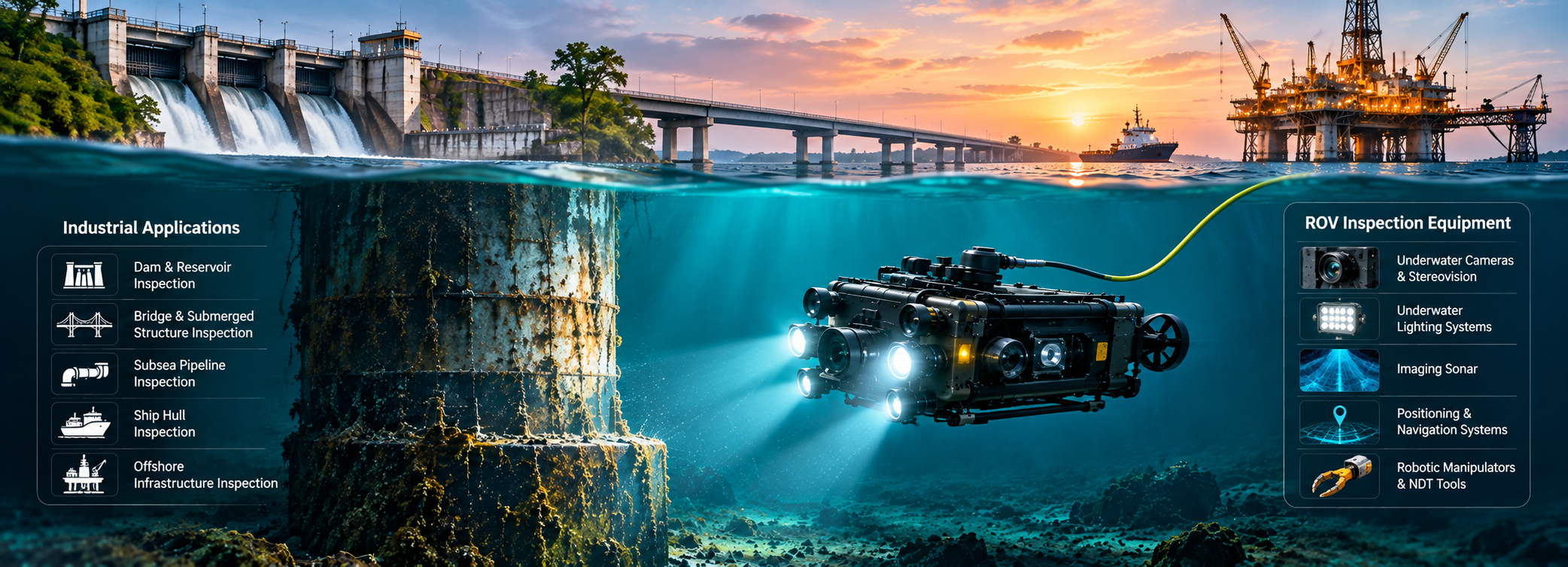
1. Underwater Cameras and Stereovision Systems
High-resolution underwater cameras provide visual documentation of submerged structures. They help operators examine surface conditions, identify visible damage, observe marine growth and record the condition of structural components.
Some advanced ROVs, such as Coratia's JalaSimha, use stereovision systems to capture three-dimensional underwater images, supporting detailed visual inspection and navigation.
2. Underwater Lighting Systems
Natural light diminishes rapidly with depth, while suspended sediment can further reduce visibility. Integrated lighting systems illuminate the inspection area, helping cameras capture clearer images of structural surfaces and components.
Lighting configuration is particularly important when inspecting enclosed spaces, submerged industrial structures and areas with limited ambient light.
3. Imaging Sonar
In environments where suspended sediment, turbidity or poor lighting restrict camera visibility, underwater sonar provides another means of examining the surroundings.
Imaging sonar can help operators identify structural outlines, obstructions and nearby objects even when visual identification is difficult. It also supports navigation around structures in challenging underwater conditions.
4. Positioning and Navigation Systems
ROV positioning and navigation systems help operators maintain control of the vehicle and relate inspection observations to specific sections of an underwater structure. Positioning requirements vary depending on the inspection area, vehicle configuration and mission objectives.
These technologies help relate collected inspection data to specific sections of an asset or survey area.
5. Robotic Manipulators and Inspection Tools
ROVs equipped with robotic manipulators can perform controlled underwater tasks, including handling objects and accessing specific components for closer examination.
Some advanced systems also carry specialised non-destructive testing (NDT) equipment. For instance, Coratia's JalaSimha ROV is equipped with a thickness gauge and laser scaler, which support the assessment of metal thickness, corrosion and defects.
Major Industrial Applications of ROV Underwater Inspection
The applications of ROV technology extend across several industries where submerged infrastructure plays an important operational role.
1. Dam and Reservoir Infrastructure
Dams contain several submerged components that require periodic assessment, including sluice gates, intake structures, spillways, trash racks and underwater concrete surfaces.
ROVs can help inspect these areas without requiring the reservoir to be drained. Camera systems and sonar can document visible cracks, corrosion, obstructions, sediment accumulation and other anomalies.
Underwater dam inspection also supports the assessment of areas that may be difficult or hazardous for divers to access.
2. Bridge Foundations and Submerged Structures
Bridge piers, piles and foundations remain exposed to changing river conditions, sediment movement and scour.
ROV-based underwater bridge inspection can help examine submerged foundation surfaces, identify visible structural damage, document debris accumulation and assess scour zones.
Sonar can supplement visual inspection by providing information about the surrounding riverbed and submerged structural features.
3. Offshore Oil and Gas Infrastructure
Offshore installations depend on extensive underwater infrastructure, including subsea pipelines, risers, platform jackets, supports and submerged equipment.
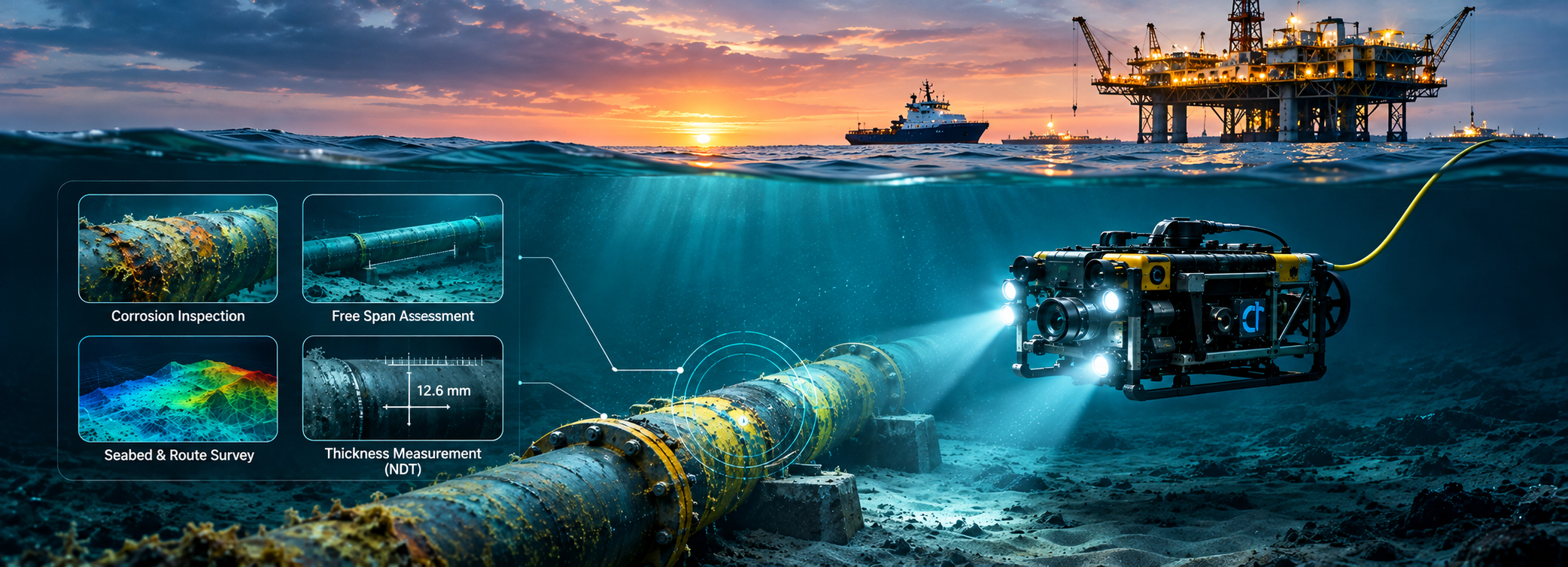
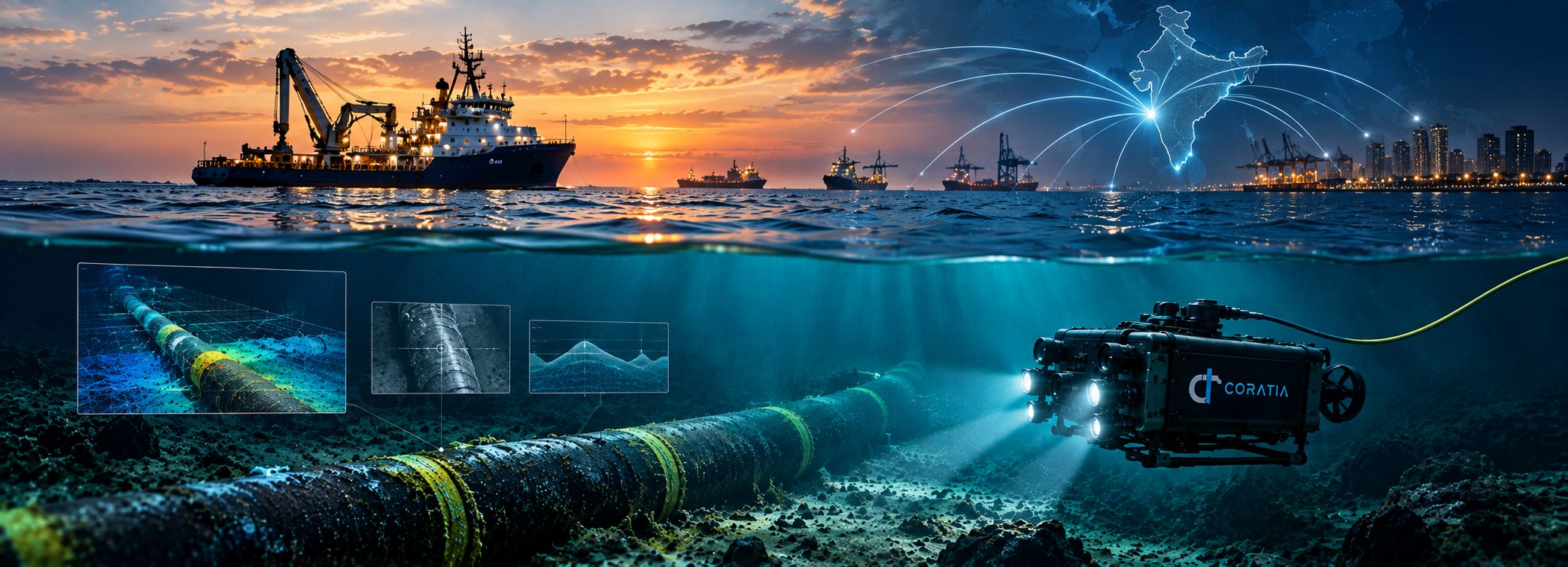
ROVs can support offshore inspection by documenting external pipeline conditions, identifying corrosion indicators, examining marine growth and recording structural anomalies.
Where configured with suitable measurement equipment, ROVs can also support ultrasonic thickness measurement and other inspection activities.
4. Ship Hulls and Port Infrastructure
Ship hulls, propellers, rudders, moorings, quay walls and submerged port structures require regular underwater assessment.
ROVs can help inspect these components without relying exclusively on diver-based operations. Their visual and sonar capabilities can support hull-condition documentation, obstruction detection and underwater infrastructure surveys.
Depending on the vehicle configuration, robotic systems can also support underwater cleaning and minor manipulation tasks.
5. Industrial Pipelines and Submerged Assets
Industrial facilities often operate pipelines, tanks, cooling-water systems, channels and other submerged infrastructure.
ROV underwater inspection can help document external pipeline conditions, coating damage, corrosion indicators, supports, joints and debris accumulation.
These inspections can provide maintenance teams with visual and measurement-based information while reducing the operational requirements associated with dewatering or accessing confined underwater spaces.
The Role of ROVs in Low-Visibility Underwater Environments
One of the most significant challenges in underwater inspection is that visibility cannot always be relied upon.
Indian operating environments can include silt-laden rivers, monsoon-fed reservoirs, working harbours and industrial water systems where suspended particles limit the effectiveness of conventional camera-based inspection.
An underwater inspection robot must therefore rely on more than visual imaging alone.
A combination of underwater cameras, controlled lighting and imaging sonar can help operators navigate and examine submerged structures under different visibility conditions.
The selection of equipment depends on the nature of the water body, the inspection depth, the structure being examined and the level of detail required.
This makes mission-specific system configuration an important part of effective ROV underwater inspection services.
How Coratia Is Advancing Underwater Inspection Capabilities
At Coratia Technologies, underwater robotics is focused on developing systems for underwater inspection, maintenance and industrial applications.
One of its key platforms, the JalaSimha ROV, has a depth capability of up to 300 metres. It features a stereovision system for three-dimensional imaging, an integrated robotic arm and non-destructive testing equipment, including a thickness gauge and laser scaler.
Coratia's portfolio also includes JalaDuta, designed for underwater cleaning and inspection, and Oceanaus, an underwater inspection and maintenance platform with a depth capability of up to 150 metres.
Through its ROV inspection services, Coratia works across applications such as dam gates, bridge foundations, ship hulls, port structures, pipelines and offshore infrastructure.
These systems bring together underwater access, imaging and specialised inspection equipment to help asset owners and engineering teams document the condition of submerged infrastructure.
The Way Forward for Industrial Underwater Inspection
As India's industrial and infrastructure networks expand, the need to understand the condition of submerged assets will become increasingly important.
Inspection is no longer limited to identifying visible damage during periodic maintenance. It is also about developing consistent records, understanding changes over time and identifying areas that may require closer technical assessment.
ROVs provide an important layer of this capability by bringing together remote access, imaging, sonar, positioning and specialised measurement equipment.
For industries managing critical underwater infrastructure, the future of inspection will depend on technologies that can reach difficult environments, capture reliable evidence and support informed engineering decisions.
Because maintaining infrastructure above the waterline begins with understanding what lies beneath it.