Article
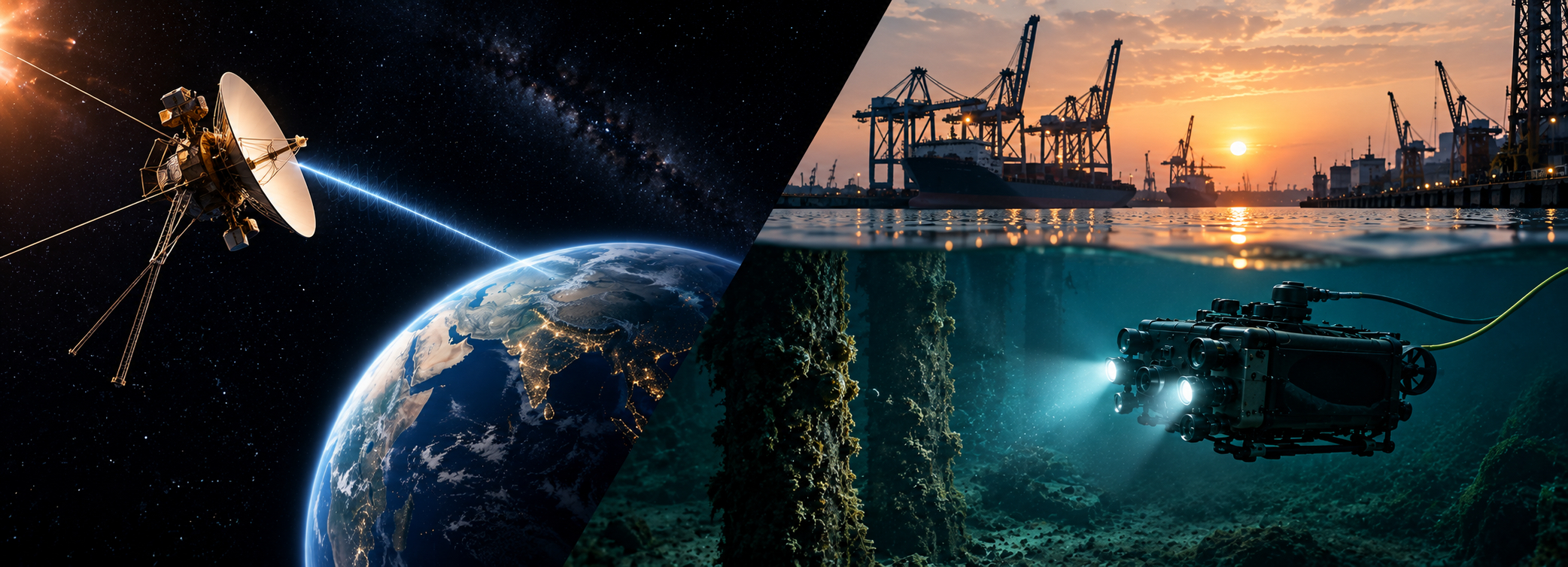
We can monitor a spacecraft millions of kilometers away from Earth in near real-time. We cannot apply the same approach to a robot operating two hundred meters beneath the surface of an active harbor.
Most people are surprised by this asymmetry when they first hear about it, and it does not stem from a lack of engineering effort or investment. It's physics. Grasping this concept elucidates nearly all aspects of why underwater robotics remains one of the most challenging domains, why only a limited number of teams globally have mastered it, and why developing this capability domestically is preferable to purchasing it.
The Physics Of The Hardest Frontier
All phenomena above water are powered by electromagnetic waves traveling at nearly the speed of light. Radio, satellite links, GPS, and mobile networks all rely on a medium that allows electromagnetic waves to propagate. Seawater does not. Because seawater is conductive, it attenuates electromagnetic signals at a rate of approximately 4 dB per meter at 1 MHz, restricting practical radio communication to distances of less than 10 meters at frequencies exceeding 100 kHz. Beyond that point, radio ceases to be a viable option entirely.
Consequently, underwater systems rely on sound. And the sound is slow. Acoustic waves propagate through water at approximately 1,500 m/s, resulting in a latency of about 0. 67 seconds per kilometer; delays that are roughly 200,000 times greater than those found in terrestrial radio networks.
Slowness accounts for only half of the challenge. The channel is also quite narrow. Current acoustic technology achieves bit rates of only a few kilobits per second over several kilometers, and multipath propagation further complicates the channel by introducing frequency selectivity, random time variations, and Doppler effects. A commonly referenced summary characterizes the underwater acoustic channel as a hybrid that combines the most challenging aspects of radio channels: the poor link quality typical of mobile terrestrial radio and the high latency associated with satellite links.
Next, there is navigation. Since electromagnetic waves barely penetrate seawater, underwater nodes are unable to determine their position or synchronize time using global navigation satellite systems.
When those constraints are assembled, the design brief becomes stark. You are designing a machine to function on a kilobit communication link with second-level latency and no satellite positioning, all within an environment that is dark, pressurized, corrosive, and in constant motion.
What The Constraint Forces You To Build
Once you accept the physics, the engineering consequences follow naturally. Here at Coratia Technologies, our work with designs and manufacturing underwater robotic systems, serves as an excellent example because its product decisions align with each constraint.
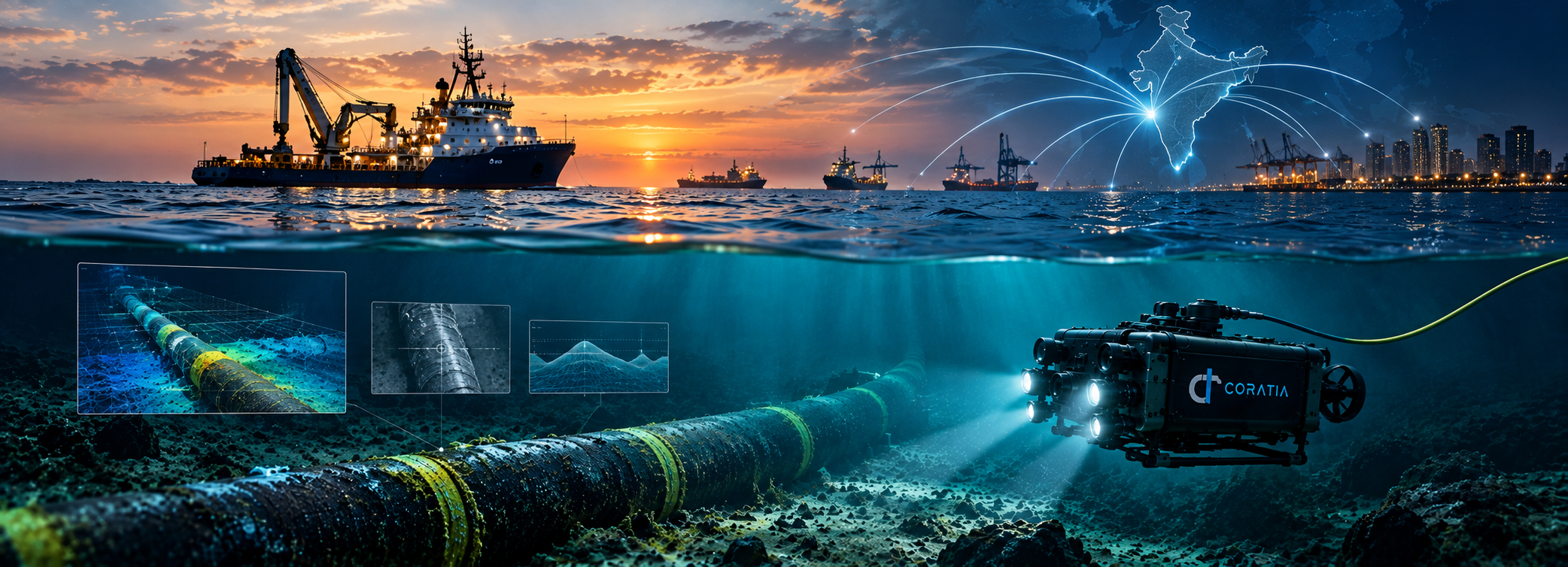
Positioning must be built, not merely received. Since GNSS signals are unavailable underwater, the vehicle must maintain its own positioning stack, combining USBL and DVL data with surface GPS to determine a georeferenced position. Coratia's platforms integrate this feature precisely, and its commercial significance lies in the fact that without it, an inspection yields a video rather than a formal record. The position allows an operator to return to the same defect next year and measure its progression.
Autonomy ceases to be a mere feature and transforms into an essential requirement. When control inputs are delayed by even a few seconds, teleportation quickly reaches its operational limits. The vehicle must make its decision locally. Debendra Pradhan, Co-Founder and CEO, believes that the industry has not yet fully achieved Level 4 on the standard autonomy scale, and that the next decade will be defined by bridging this gap through systems that operate for longer durations, with greater reliability, and requiring less human intervention.
Reliability must be demonstrated rather than merely claimed. In an environment where real-time observation is impossible, failure is not an event you can watch unfold and immediately correct. It is something you realize only afterward. This explains why Coratia’s testing discipline is intentionally slow, involving extensive trials across diverse waters and conditions before any product reaches a customer. As Pradhan explains, we never accept mediocrity, which in practice means resisting the urge to deploy prematurely. This is also why the company’s flagship UWROV, Jalasimha, reached Technology Readiness Level 9 before the Indian navy inducted it under a ₹66 crore contract via iDEX.
Why Indian Waters Make It Harder Still
A second layer, which is seldom found in international product documentation, exists.
The operating conditions in India are far more challenging than the ideal scenarios typically shown in most manufacturers' demonstration videos. These are silt-laden rivers, monsoon-fed reservoirs, working harbours, and estuaries where visibility drops to less than a metre and where thermal and salinity gradients cause acoustic behaviour to shift from season to season.
A system designed for Mediterranean or North Sea conditions does not necessarily perform well in the Hooghly or Mandovi. The discrepancy between datasheet specifications and actual site performance is one of the strongest arguments for designing specifically for the site.
It also serves as a commercial advantage instead of a constraint. Coratia's systems are currently deployed with SAIL, Indian Oil, Indian Railways, Tata Steel, and the Navya, a diverse portfolio made possible because the platforms were specifically engineered for the aquatic environments in which they operate.
The Strategic Case
India's peninsula is bordered by water on three sides, featuring a coastline that stretches approximately 7,500 kilometers. Ports, dams, pipelines, undersea cables, and naval assets all reside within a domain that demands this technology for inspection and security.
Developing domestic capability accomplishes three objectives at once. It lowers exposure to foreign supply chains for a strategically sensitive technology. It places design authority in the hands of engineers who understand Indian conditions. Instead, it creates an export position rather than a permanent import position.
Pradhan highlights a key aspect of startup contributions that is worth noting: smaller firms offer speed and cost advantages that established players struggle to replicate, and today's Indian ecosystem; via initiatives like iDEX and similar programs, is significantly more inclined to source from grassroots innovation than it was ten years ago. It is that specific combination that transforms a technical capability into a national one.
Where This Is Heading
The demand curve is becoming steeper, a trend that is evident in national programs.
Approved by the Union Cabinet in June 2021 with a five-year budget of ₹4,077 crore and implemented by the Ministry of Earth Sciences, the Deep Ocean Mission serves as India's flagship underwater initiative designed to support the government's Blue Economy goals. The centerpiece of the system is the Matsya 6000, an indigenously developed submersible designed to transport three aquanauts to a depth of 6,000 meters, offering a 12-hour operational duration and 96 hours of emergency endurance. The roadmap encompasses shallow-water demonstrations extending to 500 meters, followed by integration and deep-water testing by mid-2027, and concludes with scientific exploration using the Matsya 6000 during the 2027–28 period.
Each of these missions encounters the same underlying physics described earlier, and each generates a demand for the surrounding layers; survey, inspection, monitoring, and intervention.
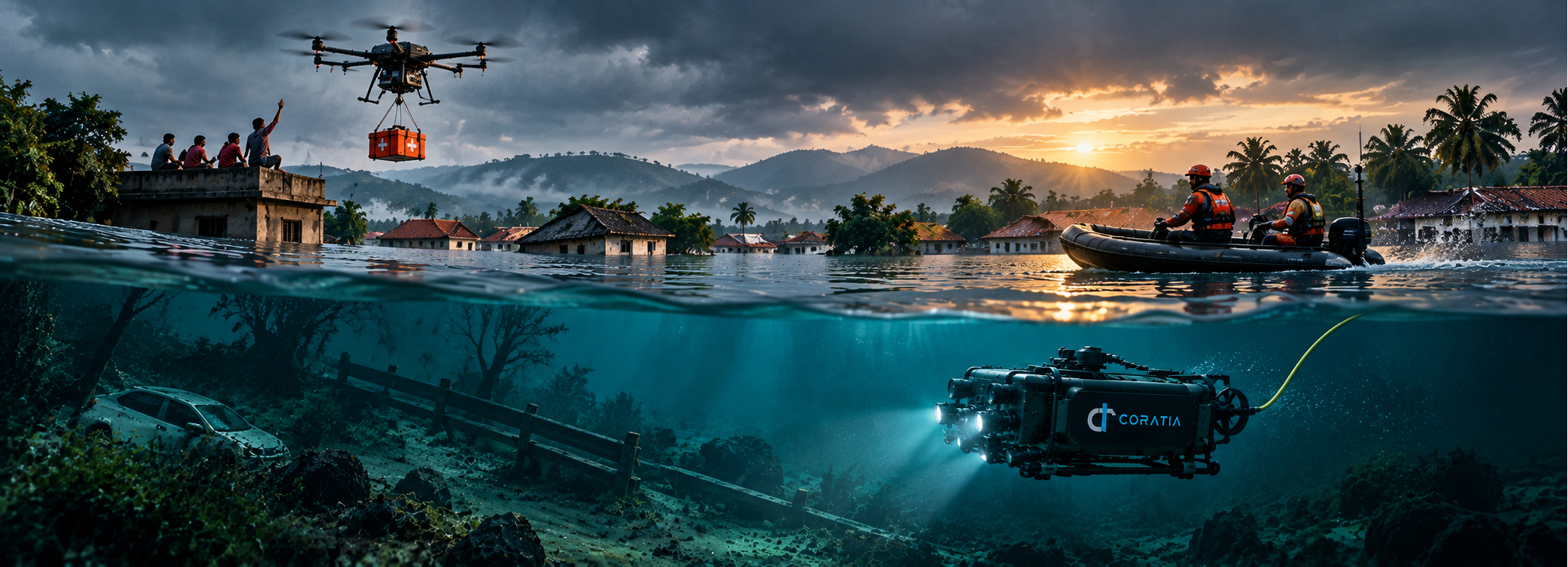
In addition to defense and deep-sea exploration, the applications expand to include offshore wind and wave energy, port infrastructure inspection, subsea cable and pipeline integrity, environmental monitoring, aquaculture, and disaster response. In each instance, a vehicle that performs reliably in low-bandwidth, high-latency, and zero-GPS environments replaces a solution that is slower, more expensive, or more hazardous.
The Point
The challenges inherent in underwater robotics are persistent and unlikely to disappear. The physics of seawater is unlikely to improve. What gets better is the engineering surrounding it; autonomy that makes up for limited bandwidth, positioning that compensates for fewer satellites, and reliability that offsets the lack of a real-time connection.
This engineering can be executed in India, tailored to local conditions, at a cost that enables national-scale deployment rather than limiting the technology to flagship programs. It is already being done. And on the evidence of the last four years, it travels.