Article
India’s offshore energy infrastructure is entering an important phase of renewal and modernisation. As offshore fields mature and existing assets continue to support the country’s energy needs, keeping this infrastructure safe, reliable and efficient is becoming increasingly important.
A key part of this ecosystem is the network of subsea pipelines that connects offshore production facilities with processing and transportation infrastructure.
ONGC is undertaking major Pipeline Replacement Projects across its Western Offshore fields as part of this effort to renew and strengthen critical infrastructure. This includes approximately 285 km of subsea pipeline under PRP-9 across Mumbai High, Neelam-Heera, Bassein and satellite fields, along with extensive topside modifications across offshore platforms.
Projects of this scale are not only about replacing ageing infrastructure. They also highlight the importance of knowing the condition of these assets before, during and after intervention. Subsea pipelines operate in environments where access is naturally difficult, and issues such as corrosion, free spans, changes in burial depth, structural damage and material loss may not always be visible from the surface.
This makes regular inspection and integrity assessment an important part of offshore asset management.
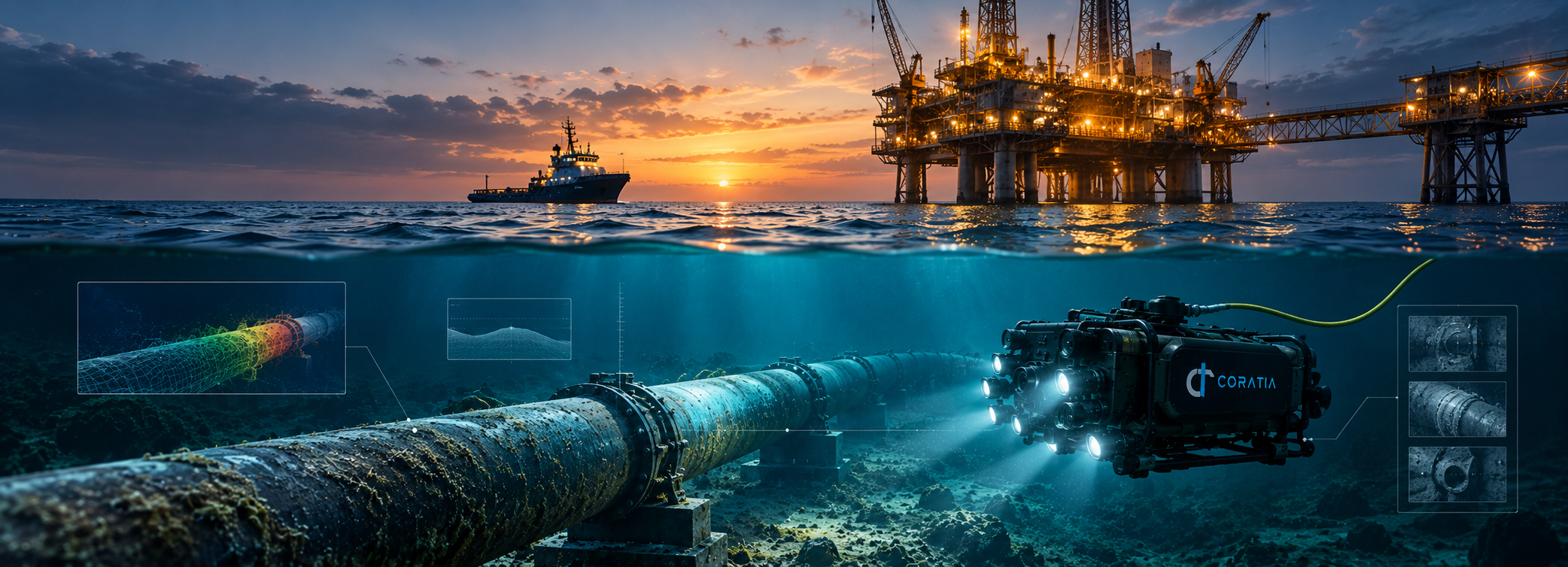
Subsea robotics can play a key role here. Remotely operated vehicles (ROVs) allow inspection teams to examine underwater infrastructure without putting divers in challenging conditions for every task. Equipped with cameras, sensors and specialised inspection tools, ROVs can support activities such as visual inspection, free-span measurement, burial-depth assessment, corrosion mapping and ultrasonic thickness measurement.
These systems can also make inspections more consistent. Data collected over multiple inspection cycles can help operators track changes in asset condition, prioritise interventions and plan maintenance more accurately.
ONGC’s own subsea pipeline scopes include ROV-based integrity inspection alongside installation and rehabilitation activities, showing how robotic inspection is becoming an important part of offshore infrastructure management.
At Coratia, our offshore service capabilities span platform and subsea infrastructure inspection, pipeline integrity assessment, corrosion and structural health monitoring, and ultrasonic thickness measurement. Our experience includes offshore and industrial inspection work in India, including with IOCL at Paradip. We have also been invited to Brunei Darussalam to demonstrate integrated robotic systems for subsea inspection of offshore energy infrastructure.
As India continues to invest in modernising its offshore energy infrastructure, there is an opportunity to build a stronger domestic ecosystem around the technologies needed to inspect, monitor and maintain these assets. Indigenous subsea robotics can help reduce dependence on external capabilities while enabling systems suited to India’s operating environments and infrastructure needs.
Offshore infrastructure will continue to evolve. So must the way we inspect and maintain it.
Understanding what is happening beneath the surface is essential to making critical assets safer, more reliable and more resilient throughout their operational life.
As India builds the next generation of offshore infrastructure, the technology to inspect India’s offshore assets should be built in India, for India’s offshore needs.