Article
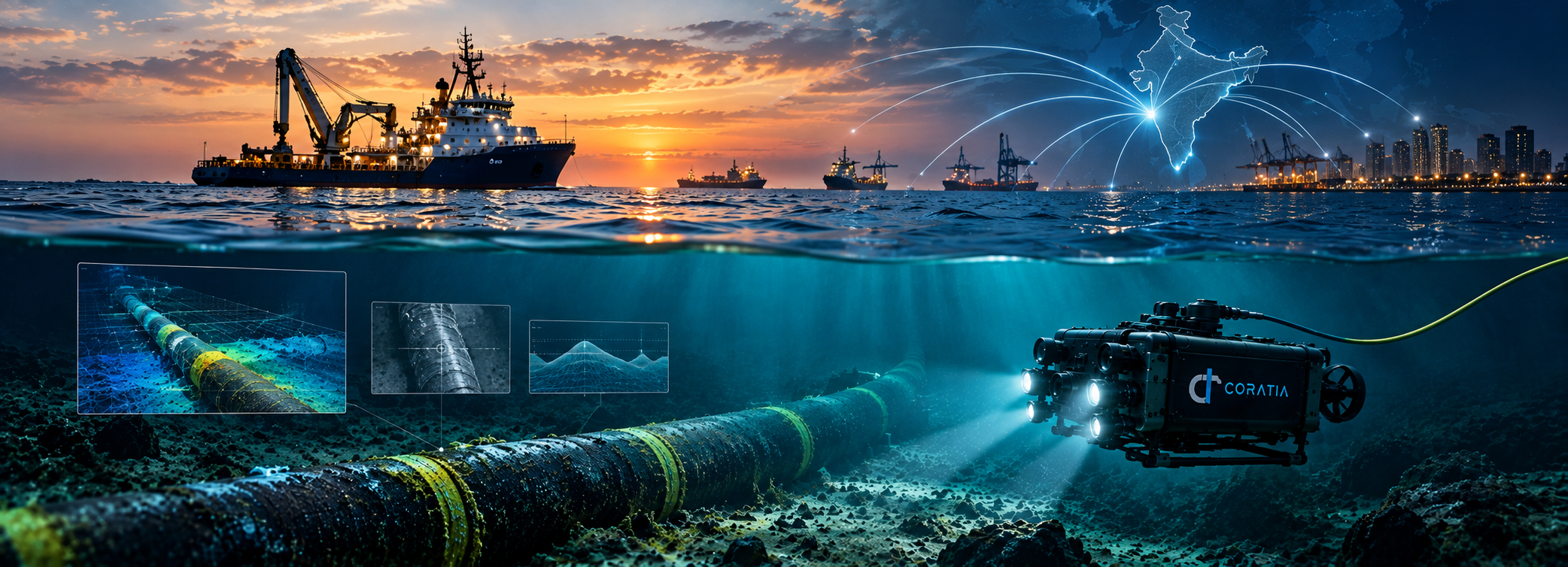
At Coratia Technologies, we design and build underwater robotic systems, including remotely operated vehicles and autonomous surface vessels, that are used to inspect, survey, and map the underwater environment. In addition to our ROV fleet, our ASV Navya conducts hydrographic and bathymetric surveys using integrated GPS, USBL, and DVL positioning systems, generating bed profiles precise enough to be compared across successive surveys.
That final aspect, comparability, is why we continually return to reservoirs. Among the assets we manage, the most frequently asked question, rarely answered with certainty, is how much storage capacity this reservoir currently holds. It is a straightforward question. For the majority of India’s reservoirs, the most accurate response is often an estimate, and frequently an outdated one.
The Numbers India Currently Owns.
The 2024 Compendium on Sedimentation of Reservoirs in India, published by the Central Water Commission, serves as the authoritative national record on this subject. As the fifth edition of a series launched in 1991, its expansion tells its own story: from 46 reservoirs in 1991, to 144 in 2001, 243 in 2015, 369 in 2020, and 548 in the 2024 Compendium.
Of the 548 reservoirs, 466 underwent hydrographic surveys, and usable data were obtained for 439 of them. Across those 439, the computed average loss in gross storage due to siltation is 19.24%. Nearly a fifth of gross storage is gone.
That single figure alone warrants national attention. However, the more valuable insight lies in the process by which it was derived.
Why The Picture Appears Thinner Than the Numerical Data Suggests.
India has over 6,000 designated dams. The 2024 Compendium analyzes 439 of them. That constitutes a substantial and rigorous body of work, which is also merely a sample.
Sedimentation is also highly regional. According to the Compendium, the maximum average sediment deposition rate in gross storage for Region 7, which encompasses west-flowing rivers beyond the Tapi and south Indian rivers, is 3.37 thousand m3/sq km/year, whereas small reservoirs with a capacity of 20 MCM or less average 1.09 thousand m3/sq km/year. A national average masks the very variations that an individual operator requires for planning purposes.
Independent research indicates that the tails is heavier than the mean. A 2025 peer-reviewed study by IISER Bhopal, which analyzed official records for large reservoirs exceeding 100 MCM across seven regions, revealed that several have already lost more than half of their designed storage capacity, with projections indicating that by 20250, at least ten east-flowing and seven west-flowing reservoirs could surpass this threshold, particularly in the Himalayan region, Narmada - Tapi basin, Western ghats, and Indo-Gangetic plains.
This is supported by regional evidence. In December 2025, the Ministry of Jal Shakti informed Parliament that sedimentation had reduced the combined storage capacity of 24 reservoirs across Punjab, Himachal Pradesh, and Haryana by approximately one-fifth.
This does not detract from the CWC’s work, which is meticulous and becoming increasingly comprehensive. This is an observation regarding frequency and coverage. A survey program that has expanded from 46 to 548 reservoirs over three decades is monitoring a process that never ceases.
Why This is More Significant in 2026 than it was in 2020.
Storage serves as India’s buffer against the uneven arrival of the monsoon. As of August 13, 2026, the live storage in the 166 reservoirs monitored by the CWC was 109.112 BCM, representing 59.44% of their live capacity, compared to 135.644 BCM during the same period last year. These 166 reservoirs contain 183.565 BCM of live storage capacity, representing approximately 71.2% of India’s estimated national total of 257.812 BCM
Earlier in the year, the volatility was even more pronounced. Storage dropped from 71.082 BCM on April 30, 2026, to 63.232 BCM by May 14, representing a loss of approximately 8 BCM over a two-week period. This is the fact that is often overlooked. Each of those percentages is calculated based on the designed capacity. If a reservoir has silently lost a fifth of its total storage capacity to sediment, its operational buffer is smaller than reported, not due to any error in reporting, but because the reference storage figure predates the accumulation of sediment on the reservoir bed.
Sedimentation does not merely decrease storage capacity. It undermines the precision of every figure constructed upon it.
The Policy is Well-Founded. It Requires Measurement to Function
India’s strategy in this regard is well-grounded. Issued in October 2022 by the Ministry of Jal Shakti, the National Framework on Sediment Management correctly prioritizes curbing silt generation at the source over repeated desilting, serving as a guiding document for states, union territories, and central ministries. The Jal Shakti Minister has made it clear that large-scale desilting is not a technically viable long-term solution.
The economic factors support that stance. Desilting operations at certain dams in Tamil Nadu, carried out under the World Bank-supported DRIP programme, have incurred costs exceeding ₹ 18.19 crore and ₹13.26 crore, respectively.
Implementing source control is the optimal approach. However, a strategy focused solely on reducing sediment generation can only be validated through downstream measurements. Whether catchment treatments, afforestation, and check dams slow deposition rates is ultimately determined by the condition of the reservoir bed.
This elevates survey frequency from a mere engineering task to a policy instrument.
What Autonomous Survey Actually Changes
This is where the economics turn favourable, and it is why we built Navya. A bathymetric survey is inexpensive relative to the asset it measures. Set against a reservoir worth hundreds or thousands of crores, and against desilting interventions costing tens of crores each, the survey is a rounding error. What has historically limited survey frequency is not the price of the data but the effort of acquiring it; crewed boats, manual sounding lines, mobilisation to remote reservoirs, and post-monsoon windows that close quickly.
An autonomous surface vessel changes that equation on three fonts
Repeatability. With integrated GPS, USBL and DVL positioning, a survey line can be flown again next year within tolerance. This is what converts a bathymetric survey from a snapshot into a time series, and a time series is what tells an operator not just their capacity, but their rate.
Reach. A vessel that can be transported, launched and operated by a small team makes it practical to survey mid-sized and small reservoirs, which is precisely where national coverage is thinnest.
Safety and simplicity. No crew on the water for the routine acquisition, and a shorter operational window per reservoir.
Our platforms are engineered for Indian condition specifically; slit laden water, monsoon-fed reservoirs, variable visibility. That reliability standard is the same one that took our flagship UWROV Jalasimha to Technology Readiness Level 9 and into service with the Indian Navy under a ₹66 crore contract through iDEX. We apply it to civil survey work because the environment demands it just as much.
What We Would Say to a Reservoir Operator
The jal Shakti Ministry’s All India Water Secretaries’ Conference in july 2026 placed dam reservoir rule curves and completion of Comprehensive Dam Safety Evaluation under the Dam Safety Act among its eight priority agenda items. Both depend on knowing current storage. A rule curve calibrated to designed capacity manages a reservoir that no longer exists.
India has built an impressive institutional apparatus for this; the CWC’s Compendium series, DHARMA, The NFSM and the DRIP. the framework is genuinely world-class. What would it operate at full strength is a measurement layer that runs annually rather than occasionally, at a cost that does not force a choice between surveying a reservoir and repairing one.
That layer is buildable now in India, with Indian technology. We know what 19.24% means as a national average. The more valuable question is what it means for the reservoir in front of you, this year; and that is a question worth being able to answer every year.