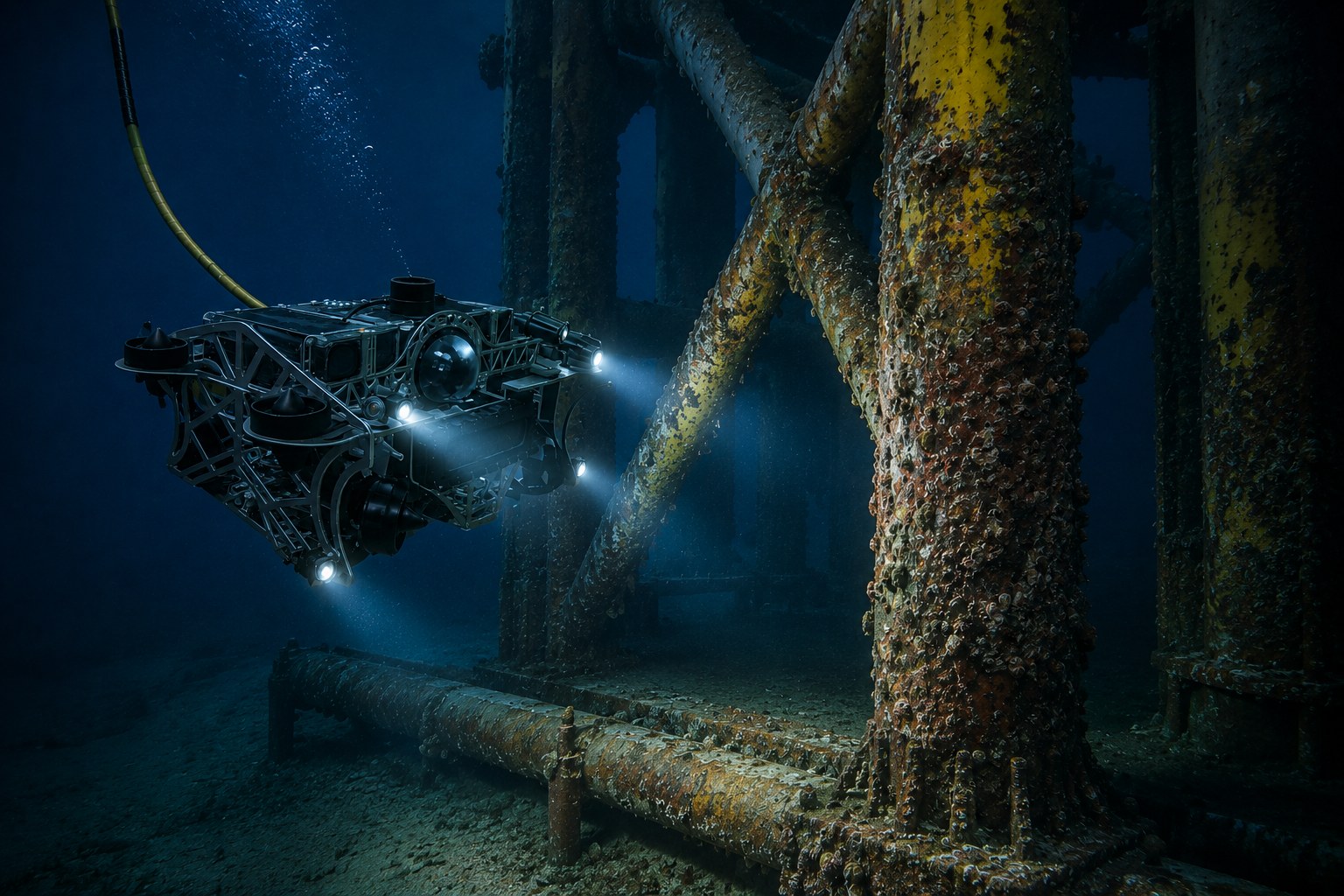
Offshore Oil & Gas ROV Inspection by Coratia Technologies

Underwater robotics service

Offshore Oil & Gas ROV Inspection

Offshore ROV inspection captures visual, sonar, positional, and measurement evidence from subsea pipelines, platform structures, risers, and associated infrastructure to support integrity and maintenance decisions.

Overview

How the service supports asset decisions

Coratia configures robotic inspection systems for industrial and offshore tasks where safe access, repeatable data, and mission documentation are important. Scope is defined around the asset, operating environment, inspection standard, required payloads, and the engineering team responsible for interpreting the findings.

Typical applications

  • Subsea pipeline route, free-span, support, and external condition checks
  • Platform jackets, structural members, risers, and submerged equipment
  • Corrosion evidence, coating condition, marine growth, and debris
  • Visual inspection and ultrasonic thickness measurement where configured

Method

Inspection and survey workflow

  1. 01

    Scope definition

    Translate integrity questions and asset drawings into inspectable targets and data requirements.

  2. 02

    System configuration

    Select vehicle, camera, sonar, positioning, tooling, and measurement payloads.

  3. 03

    Mission execution

    Capture controlled evidence with clear references to the inspected asset or route.

  4. 04

    Data handover

    Structure records and observations for the operator's integrity and engineering workflow.

Outputs

Typical deliverables

  • Inspection video, images, and mission logs
  • External condition and anomaly observations
  • Position or route references where included
  • Measurement records for configured NDT payloads

Platforms

Related robotic systems

Direct answers

Frequently asked questions

What offshore assets can an ROV inspect?

ROVs can inspect subsea pipelines, platform jackets, risers, supports, moorings, subsea equipment, and other accessible underwater structures.

Can an ROV measure metal thickness?

Yes. An ROV can carry suitable ultrasonic thickness measurement equipment where the vehicle, surface condition, access, coupling method, and inspection procedure support its use.

Does ROV footage replace an integrity assessment?

No. ROV data provides inspection evidence. A qualified engineering or integrity team should interpret the findings against asset design, history, standards, and operating conditions.

Can ROVs inspect subsea pipelines?

Yes. ROVs can support visual and configured measurement inspections of accessible pipeline sections, including external condition, supports, crossings, marine growth, corrosion indicators, and debris.

Can ROV inspection be performed in low-visibility offshore conditions?

Yes. Depending on mission requirements, ROVs can use imaging sonar and other sensors to support navigation and inspection when water turbidity limits camera visibility.

What information is needed to plan an offshore ROV inspection?

Useful information includes asset drawings, inspection objectives, water depth, access constraints, operating conditions, previous inspection records, target areas, and required measurement or NDT payloads.

Explore related underwater services